

Lifting a Class C RV: What Happens to Your Leveling Jacks and Hitch
A lift changes more than ride height. Here's what it does to your leveling jacks and receiver, and how to tell whether you need a lift at all or just a better ride.
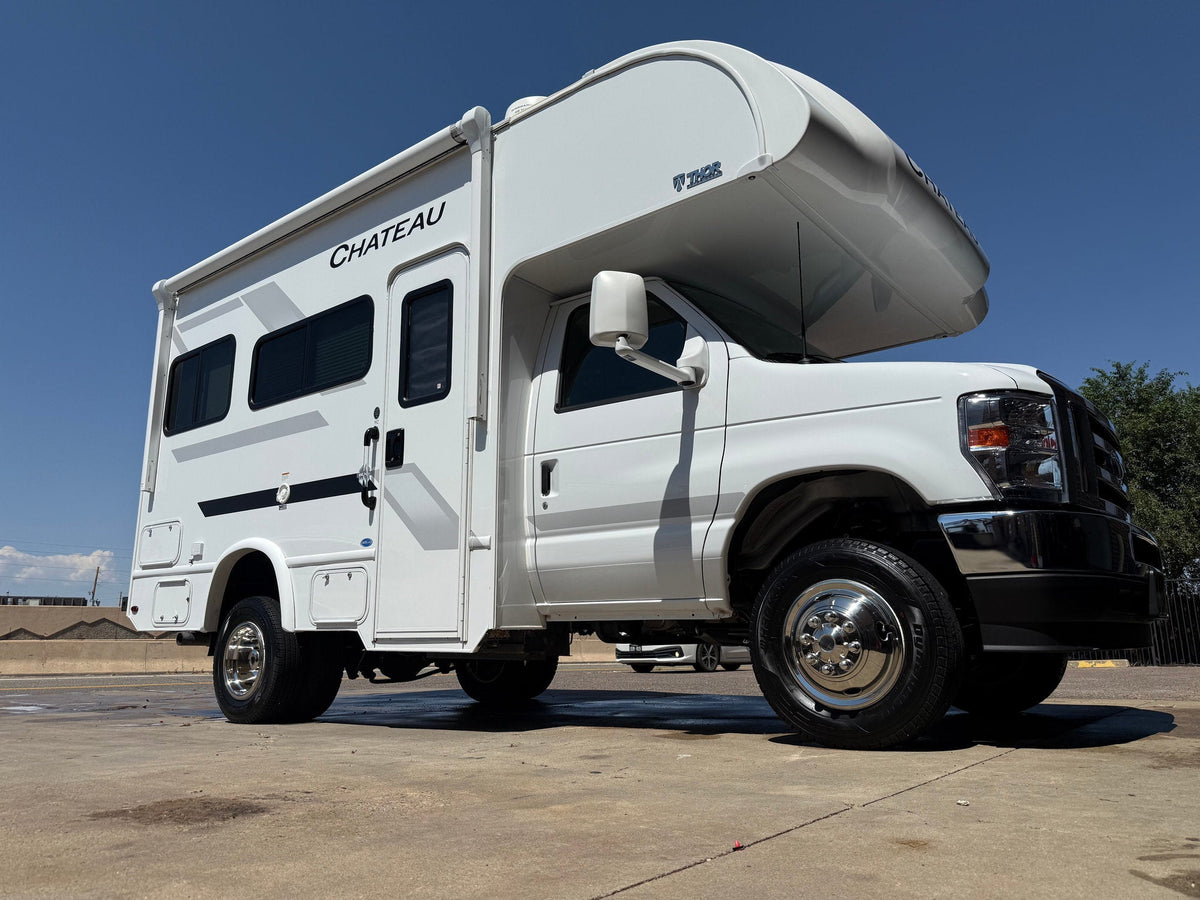
You weighed the coach. You read the lift kit page twice.
Now you're standing next to it, looking at the leveling jacks hanging under the frame and the receiver on the back, and doing math in your head.
Two inches up means two inches farther for the jacks to reach the ground, right? And the receiver goes up too, so whatever you tow sits nose-up?
Fair questions. Both have real answers.
But they're usually not the question that matters most. The question that matters is whether your coach needs height at all, or whether it just needs to stop riding like a box truck.
Quick answer
On a Ford E-Series Class C, a lift raises the frame, so the leveling jacks and the receiver both go up with it. If your jacks ever need to be relocated to clear the new suspension parts, we handle that during installation. The receiver rises with the rear of the coach, which can be more than the advertised number (the Getaway lifts the rear 3–4"), and a drop hitch puts your tow setup back where it belongs. If a smoother ride is the main goal, start with your scale weights and a shock package before you decide on height.
How a Class C lift actually works
Most Class C motorhomes ride on the 2WD Ford E-350 or E-450 cutaway, the same twin I-beam front end found under an Econoline van, carrying a house-sized body. WeldTec's Class C packages don't lift that chassis with spacers. They replace the parts that set ride height and control it: modified I-beams, modified or extended radius arms, lift coils, Fox or King shocks at all four corners, and progressive rear leaf springs. Every package and what's in it is on our Ford E-Series vehicle page, and the bigger picture of Econoline lifts is in our E-Series lift kit guide.
Here's the part most owners don't expect. On the 2" Getaway package, the shop first brings the coach back to Ford's original ride height, then adds the lift from there. Most of the Class C leaf springs we see in the bay have sagged, so the coach is already sitting lower than it left the factory. Depending on how tired those springs are, a "2-inch" lift can end up raising the coach closer to 3". The listing also puts the rear lift at 3–4", because the new progressive leaf springs are built to your coach's actual weight. That's why we need a CAT scale ticket before ordering, and why the measurements that matter are the ones taken on your coach, not the number in the kit name.
What happens to your leveling jacks
Hydraulic and electric leveling jacks bolt to the frame. When the frame goes up, the jack feet start farther from the ground, and the jack has to spend part of its stroke just reaching the pad. The tilt the jacks have to correct doesn't change, because the campsite didn't change. So the honest answer to "won't a lift shorten my jack range?" is yes, it uses up part of the stroke, by roughly the amount the frame went up at that jack.
Leveling jacks usually come from the factory on adjustable brackets, so they can be lowered a bit to win back some reach. On mild campsites most owners won't notice a difference, and on steep ones a set of jack pads or blocks under the feet makes up the rest.
Sometimes a jack sits right where a new suspension part needs to go. When the jacks require relocation, we handle that during installation: the shop moves them to a good spot that's clear of the new parts, so you don't have to plan for it or sort it out afterward. There's an upside to the lift, too. The same lift that moves the jacks farther from the ground also moves them farther from speed bumps, gas station aprons and steep driveways, which is where a lot of Class C owners scrape them today.
What happens to your receiver hitch
The receiver is welded or bolted to the frame behind the rear axle, so it rises about as much as the rear of the coach does. On the Getaway package that means planning for 3–4" at the rear, not 2", and possibly more if your springs are badly sagged today. The way to know for sure is simple: measure from the ground to the top of the receiver opening before the install, with the coach loaded the way you travel, then measure again after.
Whether that change matters depends on what you tow. A trailer wants to ride level. Raise the ball and the trailer tongue goes up with it, so the trailer rides nose-up, which puts less weight on the tongue and can make it sway. A flat-towed car needs the tow bar close to level, within whatever range the tow bar maker allows. Either way the fix is the same: a drop hitch or a ball mount with more drop, sized to the before-and-after measurements. It's an inexpensive part, and it's usually the only change your towing setup needs.
One thing a lift doesn't change is what the coach is rated to tow or carry. New springs and shocks help the coach control its weight. They don't raise the GVWR on the door sticker, the axle ratings or the hitch rating, and they don't add payload.
If ride quality is the real goal, start with weight
A lot of Class C owners shop for a lift when what they really want is a coach that stops bouncing after dips, leaning in crosswinds and wandering across the lane. Those complaints usually come down to two things: how much the coach weighs compared with what its suspension was set up for, and how well the shocks control that weight.
So start with the scale. Take the coach to a CAT scale loaded the way you travel, with water, propane, gear and passengers, and get the steer-axle, drive-axle and total weights. Compare them with the ratings on the door sticker. A Class C is heavy at the back by design, and it's common to find the rear axle close to its limit with only the driver aboard. A rear axle near its rating explains a harsh, busy ride better than any lift kit can fix, and it tells us how the rear springs need to be built. Our CAT scale guide shows how to get a ticket.
If the coach already sits at a height you're happy with and the complaint is ride and handling, the WeldTec Hit the Road Shock Package is the place to start. It puts Fox 2.0 shocks at all four corners plus a Fox steering stabilizer on 2WD E-350 and E-450 Class C coaches, with no lift, so your jacks and hitch stay exactly where they are. If the rear sags, the coach scrapes, or you want a little more clearance along with the ride, that's where the Getaway package earns its place: it replaces the stack of add-ons many owners have tried one at a time (heavier sway bars, helper springs, air bags, bump stops) with one matched system.
The Class C packages side by side
| Package | Lift (per listing) | From price |
|---|---|---|
| Hit the Road Shock Package | None | from $1,420 |
| Getaway 2" Lift Package | 2" front, 3–4" rear | from $4,615 |
| Adventurer 4" Lift Package | 4" front and rear | from $5,890 |
| Off-Grid 6" Lift Package (Fox) | 6" | from $6,020 |
| Off-Grid 6" Lift Package (King) | 6" | from $6,390 |
Every lift package needs an alignment after install, and the 4" and 6" packages use weld-on radius arm brackets. That makes them specialty work that takes welding and specialty equipment, so we recommend a Savage install. All of them build the rear leaf springs to your coach's weight.
Build example: a 2018 Coachmen Leprechaun on the Off-Grid 6"
This 2018 Coachmen Leprechaun, on a Ford E-450 cutaway, came to us with one problem: its plumbing hung so low that it scraped just pulling into the owner's driveway. The fix was to go up. We installed the WeldTec Off-Grid 6" Lift Package (Fox) with a steering stabilizer, then fitted Cooper Discoverer Stronghold A/T tires in 235/85R16.
A 6" lift on a Class C can mean more than bolting in the kit. To fit the new suspension, the shop relocated and replaced the black water tank and the propane tank, and removed the factory air bags, because the progressive rear leaf springs built to the coach's weight do that job. That's the kind of underbody work we sort out during installation, the same way we handle leveling jacks that need to move. The coach now clears the driveway, and the owner has the clearance for dirt roads too.


Before-the-lift checklist
- Get a CAT scale ticket loaded the way you travel (steer, drive and total).
- Photograph the door sticker with GVWR and axle ratings.
- Measure ground to the top of the receiver opening, loaded.
- Note what you tow and how: trailer or flat tow, and the tow bar make.
- Photograph your leveling jacks and the current rear leaf pack.
- Write down the one thing you most want fixed: ride, sway, scraping or clearance.
Send us that list and we can tell you which package fits, what happens to your jacks and how much drop your hitch needs, before anything gets ordered.
The Savage take
If your main complaint is ride and your coach already sits where you like it, we'd start with the scale and the Hit the Road Shock Package. It's the least invasive fix, and it leaves your jacks and hitch alone.
If the coach scrapes, sags in the rear or sways badly, we'd step up to the 2" Getaway. It brings tired springs back to factory height, lifts from there and rebuilds the rear springs to your weight; the hitch usually needs nothing more than a drop mount. We'd only go to 4" or 6" if you want real clearance for rough roads and you're comfortable with a taller coach.
The bottom line
A Class C lift raises the frame, so the jacks and the receiver go up with it. If the jacks need to be relocated, we handle it during installation. The receiver rises with the rear, so plan for a drop hitch sized to real measurements. And if the ride is what bothers you, weigh the coach first, because the answer might be shocks, not inches.
Send us your CAT scale ticket and what you tow, and we'll tell you which package fits your coach and what changes with your jacks and hitch. Get an install quote for your Class C
Common questions
Will a lift kit shorten the range of my leveling jacks?
Yes, by about how far the frame goes up at each jack, because the jacks have to travel farther to reach the ground. Factory adjustable brackets let most jacks be lowered a bit, and if your jacks need to be relocated to clear the new suspension, we handle that during installation.
How much will a lift raise my receiver hitch?
About as much as the rear of the coach rises. On the 2" Getaway the rear lift is 3–4" per the listing, and sagged springs can add more, so measure before and after and fit a drop hitch to match.
Why is the rear lift bigger than the number in the kit name?
The shop restores factory ride height first, then lifts from there, and the rear leaf springs are built to your coach's weight. If your current springs have sagged, the coach rises more than the advertised number.
I just want a smoother ride. Do I need a lift?
Not necessarily. Weigh the coach first. If it sits at a height you like, the Hit the Road Shock Package adds Fox shocks and a steering stabilizer with no lift and no change to your jacks or hitch.
Does a lift increase my towing capacity or payload?
No. A lift helps the coach control its weight, but the GVWR, axle ratings and hitch rating stay the same.
Why do you need a CAT scale ticket?
The rear leaf springs in every lift package are built to your coach's actual weight, and door sticker numbers aren't accurate enough. The weights also tell us whether a ride complaint is really a weight problem.


