

Mercedes Sprinter 2500 vs. 3500 vs. 3500XD: Which Sprinter Fits Your Camper Build?
Same body, very different load ratings, and unlike some vans, different suspension kits. Pick the Sprinter that carries the camper you're actually going to build.
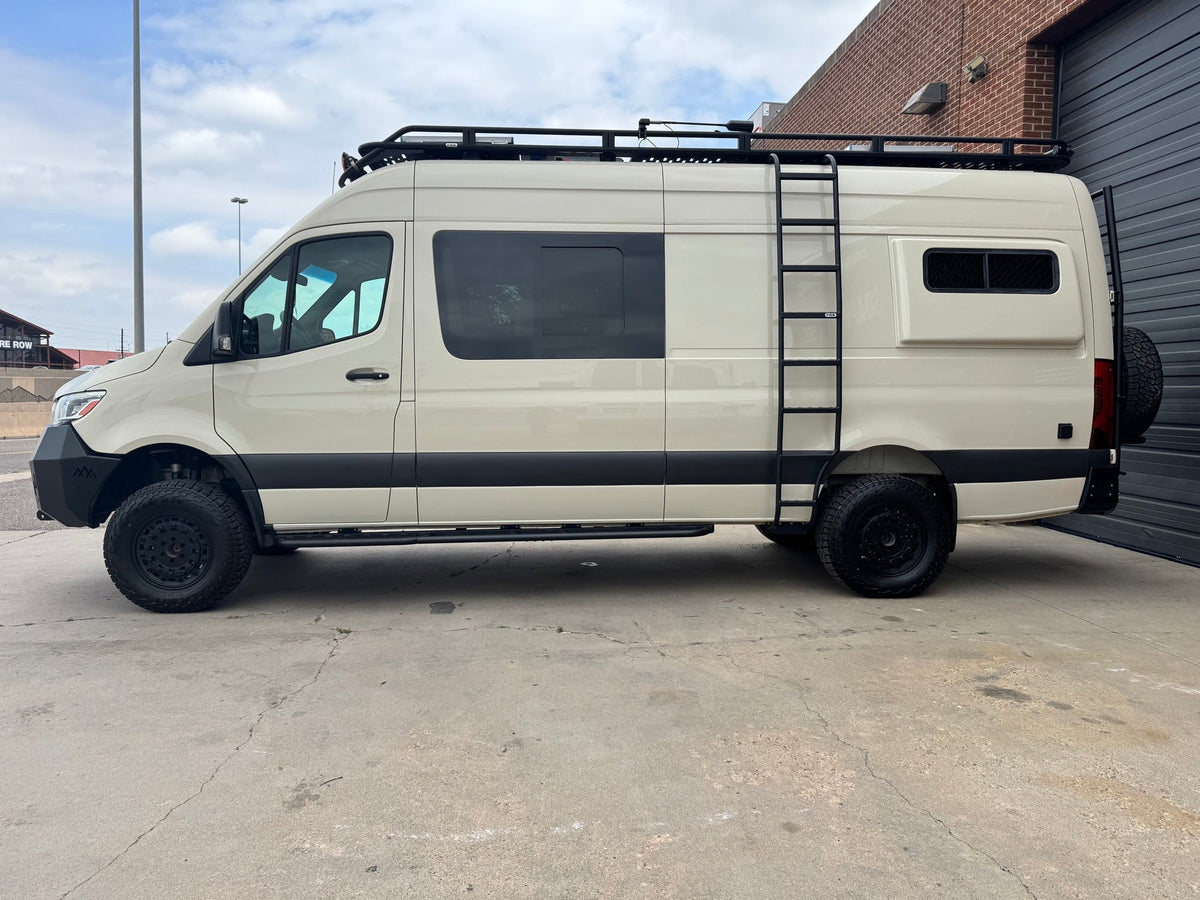
Ask a Sprinter forum which model to build on and you'll get two answers in the first hour.
One crowd says a 2500 is plenty and anything heavier rides like a work truck.
The other says a 3500 is the only safe bet once the lithium and water go in.
Both are right about their own van.
What decides it for yours isn't the badge on the back doors. It's what your camper weighs when it's finished, and what each Sprinter is rated to carry.
Quick answer
The Sprinter 2500, 3500 and 3500XD share the same body, roof heights and wheelbases. What separates them is how much weight Mercedes rates them to carry: on Mercedes-Benz Vans' current cargo van lineup, the 2500 tops out at 9,050 lb GVWR, the 3500 at 9,990 lb and the 3500XD at 11,030 lb. Unlike some vans, the suspension kits are model-specific too. Weigh or honestly estimate your finished build, then choose the model whose door-sticker payload carries it with room to spare.
Sprinter 2500 vs 3500: same van, different load rating
Park a Sprinter 2500 next to a 3500 with the same roof and wheelbase and most people can't tell them apart. The model number is about the job each one is rated for, not the trim. Each step up carries a higher gross vehicle weight rating, and the 3500XD sits above the regular 3500 for builds that run heavy every day. Mercedes also builds a 4500, the heaviest-rated cargo van in the lineup, which is mostly bought for commercial work.
Older Sprinters were also sold as a 1500, the lightest-rated version. Mercedes doesn't list a 1500 in its current cargo van lineup, so you'll mostly find one on the used market. If you're looking at one for a camper, the same rule applies: read its door sticker and make sure the payload covers your build.
Within a model, the roof, wheelbase and drivetrain move the numbers. A high-roof, 170" extended van with AWD starts out heavier than a standard-roof 144" rear-wheel-drive van, so it has less payload left for your build. Everything we sell for these vans is in the Mercedes Sprinter shop.
Sprinter payload: the number that decides it
For a camper, the number that matters most is printed on the driver's door jamb. The certification label lists the GVWR, the most the loaded van is allowed to weigh, plus a rating for each axle. Payload is what's left of the GVWR after the van's own empty weight, and a camper spends most of it on things that never come back out: cabinets, a fridge, batteries, an inverter, water, a bed platform and the gear under it. Passengers, fuel and weekend gear come out of the same budget.
Here's how Mercedes-Benz Vans lists its current Sprinter cargo vans. The payload ranges cover the standard and high roof, 144" and 170" wheelbases and rear-wheel or all-wheel drive; the low end is usually a 170" extended AWD van, the high end a 144" rear-wheel-drive van.
| Model | Max GVWR (lb) | Payload range (lb) |
|---|---|---|
| Sprinter 2500 | 9,050 | 3,351 to 4,211 |
| Sprinter 3500 | 9,990 | 4,148 to 4,699 |
| Sprinter 3500XD | 11,030 | 4,879 to 5,739 |
| Sprinter 4500 | 12,125 | 6,250 to 6,812 |
The gaps are bigger than they look. A high-roof 170" extended 2500 with AWD lists about 3,350 lb of payload, while a 3500XD with the same body lists close to 4,900 lb. That difference is a full battery bank, a water tank and two people with room to spare. Read the sticker on the van you're actually considering, not a website, and compare it with a realistic estimate of your finished build plus people and gear. If it's tight on paper before you've bought a single battery, it will be tight on the road, and that's a signal to move up a model.
Weigh the build, then pick the van
The best way to make this call is with real numbers. If you're converting a van you already own, or you've built one before, take it across a certified CAT scale loaded the way you travel and get the front axle, rear axle and total weight. Our CAT scale guide shows how to do it and how to read the ticket against your door-jamb ratings. If you're still shopping, add up the planned build honestly: batteries, water, cabinetry, fridge, roof rack and solar, bumpers, tires and everything you carry. Most people come in heavier than they expect, and a high-roof 170" build with a full-height interior adds up fast.
Hitch loads count too. A bike or motorcycle carrier, a cargo box or a trailer's tongue weight all come out of the van's payload. A load hanging behind the rear bumper also acts like a lever, putting more weight on the rear axle than the item weighs and taking some off the front tires that steer. If a carrier or trailer is part of the plan, add it to the math before you choose a model.
How each one rides once it's a camper
The empty test drive is where a lot of buyers talk themselves into the wrong van. An empty 2500 usually feels softer, and an empty 3500 or 3500XD can feel firm and busy because its rear suspension is waiting for weight that isn't there yet. Load both with a finished camper and the picture can flip: the heavier-rated van starts working in the range it was built for, while a heavily built 2500 runs closer to the end of its travel and can bounce and roll.
Either way, a Sprinter on factory springs is set up for a cargo van, and a camper puts its weight in different places and keeps it there every day. That's why so many Sprinter owners end up looking at suspension, whichever model they bought.
Sprinter lift kits and suspension: the model matters here
This is where the Sprinter differs from some other vans: suspension kits are usually built for a specific model, because the 2500 and 3500 carry different loads on different springs. Agile Offroad's RIP (Ride Improvement Package) kits come in separate versions for each. For the 2500, the Agile RIP kit for the 2WD Sprinter 2500 fits 2007–2018 and 2019-and-newer vans, and the Agile RIP kit for the 4x4 Sprinter 2500 covers 4x4 vans. Both add about 2" of lift with Fox rear shocks and rear leaf springs built to your rear axle weight, which is why we ask for a CAT scale ticket before ordering.
For the 3500, the Agile RIP kit for the 2WD Sprinter 3500 and the Agile RIP kit for the 4x4/AWD Sprinter 3500 are tuned for the heavier chassis, with Fox 2.0 rear shocks, a front coil assist kit and rear leaf springs rated from 5,500 to 7,500 lb of rear axle weight. The 4x4/AWD kit adds lift blocks for clearance. Our Mercedes Sprinter lift kit guide covers the 2500 kits in detail.
On 2019 and newer Sprinters, the factory plastic rear bumper is often the first thing to touch on a steep driveway. The Aluminess slimline rear bumper replaces it for more clearance without blocking the rear doors.
None of this turns a 2500 into a 3500 on paper. Suspension changes how the van handles its weight, but it never raises the GVWR or the legal payload on the door sticker. If the build is over the rating, the answer is less weight or a heavier-rated van.
Buying a used Sprinter: check the label and the generation
Most camper Sprinters start as used vans, and many spent their first years working. Before you buy, check the door-jamb label for the exact GVWR and axle ratings, note whether it's rear-wheel drive or 4x4/AWD, and confirm the generation: many parts, including the 2WD RIP kit options, are split between 2007–2018 and 2019-and-newer vans. Look at the springs, shocks and tires for signs it spent years overloaded. A well-kept 2500 with room in its payload is a better foundation than a worn 3500 that will cost you the savings in repairs.
The Savage take
For a weekend camper with a modest electrical system and a few days of water, a 2500 with a clear payload margin on its sticker is a great van, and the money saved can go into suspension and tires. For a full-time build with heavy lithium, lots of water, steel bumpers, big tires or a hitch load, start at a 3500 or 3500XD and check that specific van's ratings before you buy. Either way, the deciding number is the same: what your finished camper weighs, against what that exact van is rated to carry.
The bottom line
The Sprinter 2500, 3500 and 3500XD look alike, but they're rated to carry very different amounts of weight, and roof, wheelbase and drivetrain shift those numbers within each model. Estimate your finished camper honestly, or weigh it, read the door sticker on the exact van you're considering, and choose the one that carries that weight with room left over. Then match the suspension to that model. Whichever you buy, suspension improves how it carries the load, not how much it's allowed to carry.
Found your Sprinter? Send us your year, model, drivetrain, the build and your CAT scale ticket, and we'll recommend the suspension. Request an install quote.
Common questions
What is the difference between a Sprinter 2500 and 3500?
Mostly the load rating. Mercedes lists the current Sprinter 2500 cargo van at up to 9,050 lb GVWR and the 3500 at up to 9,990 lb, with the 3500XD at 11,030 lb. The body and roof options are shared, but suspension kits are usually model-specific.
Which Sprinter is best for a camper van?
The one whose door-sticker payload carries your finished build, people and gear with room to spare. Many weekend builds fit a 2500; heavy full-time builds usually belong on a 3500 or 3500XD.
Is there still a Sprinter 1500?
Mercedes doesn't list a 1500 in its current cargo van lineup. Older 1500s are on the used market; check the door sticker to see whether the payload covers your build.
Does the Agile RIP kit for the 2500 fit a Sprinter 3500?
No, the 2500 kits are built for the 2500. Agile makes separate RIP kits for the Sprinter 3500, in 2WD and 4x4/AWD versions, with springs rated for the heavier chassis.
Does a high roof or AWD change a Sprinter's payload?
Yes. A high roof, longer wheelbase and AWD all add empty weight, which leaves less payload for the build. That's why the payload figures are ranges within each model.
Can suspension upgrades increase my Sprinter's payload?
No. Springs, shocks and lift kits help the van carry its weight more steadily, but they don't change the GVWR or legal payload.


