

Ram ProMaster 1500 vs. 2500 vs. 3500: Which ProMaster Fits Your Camper Build?
Same body, same axles, three load ratings. Pick the ProMaster that carries the camper you're actually going to build.
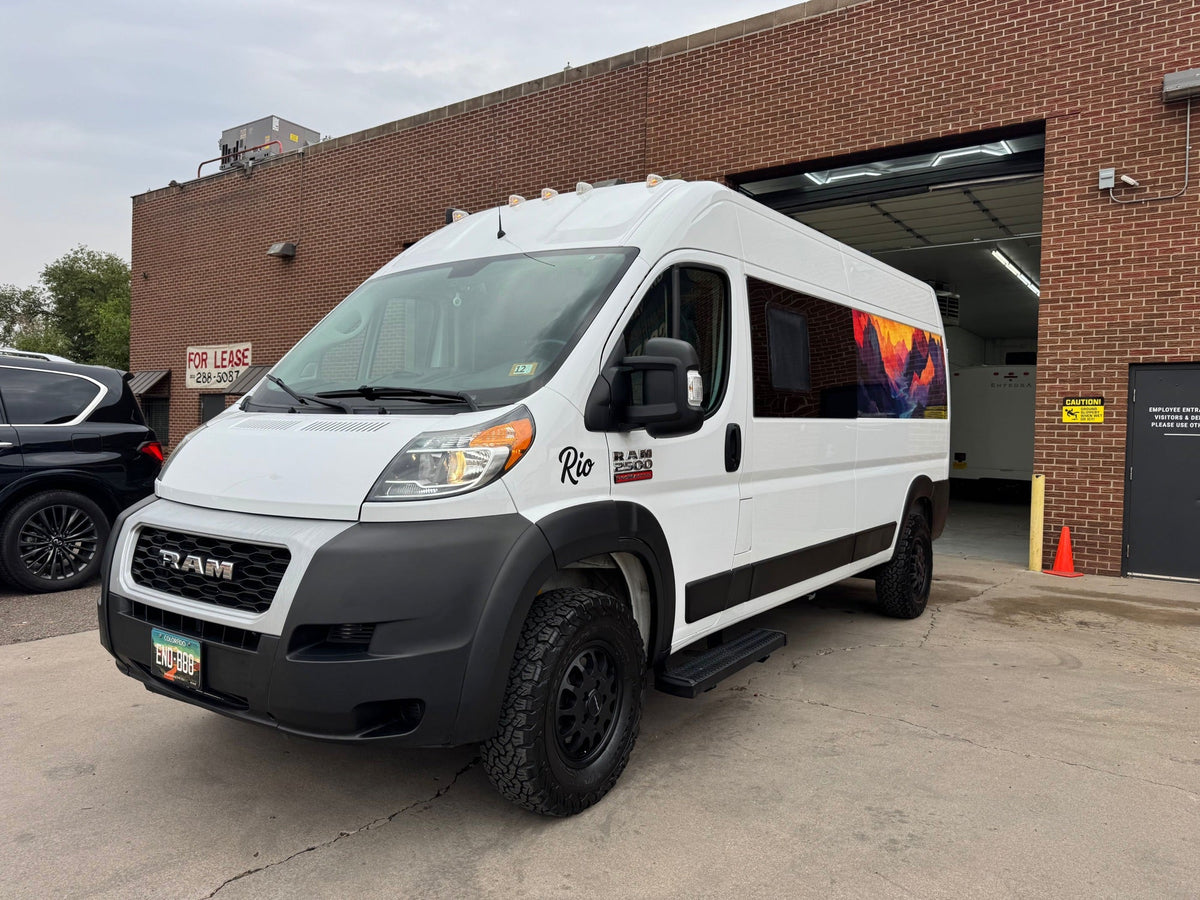
Every ProMaster camper conversation starts the same way.
Someone says the 1500 is all you need for a weekend van.
Someone else says only a 3500 will hold up once the build goes in.
Then you look at them side by side and can't find the difference.
That's because most of it isn't on the outside. It's on a sticker in the door jamb, and your finished camper decides which one you need.
Quick answer
The ProMaster 1500, 2500 and 3500 share the same body styles, the same 3.6L V6 and front-wheel drive, and in Ram's charts the same front and rear axle ratings on most configurations. What separates them is the GVWR Ram puts on each: 8,550 lb on the 1500, 8,900 lb on the 2500 and 9,350 lb on the 3500. Weigh or honestly estimate your finished build, then choose the model whose door-sticker payload carries it with room to spare.
ProMaster 1500 vs 2500 vs 3500: same van, different load rating
Ram still sells all three, and from the curb they're hard to tell apart. The model number is the weight class Ram rated that van to, not a trim level. The 1500 comes in the shorter 118" and 136" wheelbases, the 2500 in 136" and 159", and the 3500 in 136", 159" and the 159" extended body, including the Super High Roof Ram added in 2023. That same year Ram moved the whole line to a 9-speed automatic.
Two other versions are worth knowing about. Early ProMasters were also offered with a 3.0L diesel; Ram's 2016 and 2017 charts list it alongside the V6. And since 2025 there's the ProMaster EV, which Ram lists at 9,350 lb GVWR with a payload of up to 3,161 lb, a lot less than a gas 3500 because the battery is part of the van's own weight. If you're shopping either one, read its door sticker before you plan a build around it. Everything we sell for these vans is in the Ram ProMaster shop.
ProMaster payload: the number that decides it
For a camper, the number that matters most is printed on the driver's door jamb. The certification label lists the GVWR, the most the loaded van is allowed to weigh, plus a rating for each axle. Payload is what's left of the GVWR after the van's own empty weight, and a camper spends most of it on things that never come back out: cabinets, a fridge, batteries, an inverter, water, a bed platform and the gear under it. Passengers, fuel and weekend gear come out of the same budget.
Here's how Ram lists its gas ProMaster cargo vans in its 2023 weight and tow chart, the first year of the current 9-speed lineup. The payload ranges cover each model's roof and wheelbase choices; the high end is usually a low-roof, shorter van, the low end a high-roof or extended one.
| Model | GVWR (lb) | Payload range (lb) |
|---|---|---|
| ProMaster 1500 | 8,550 | 3,800 to 4,010 |
| ProMaster 2500 | 8,900 | 4,000 to 4,260 |
| ProMaster 3500 | 9,350 | 4,330 to 4,680 |
Ram's 2026 buyer's guide lists the same 8,550 to 9,350 lb GVWR spread, with cargo van payloads from 3,871 to 4,746 lb, so newer vans land in the same range. The gaps look small on paper, but they add up. A high-roof 1500 lists about 3,800 lb of payload, while a high-roof 159" 3500 lists about 4,560 lb. That difference is a battery bank and a full water tank. Read the sticker on the van you're actually considering, not a website, and compare it with a realistic estimate of your finished build plus people and gear. If it's tight on paper before you've bought a single battery, it will be tight on the road, and that's a signal to move up a model.
What's different about a ProMaster: front-wheel drive and the rear axle
The ProMaster is the only van in this series built around front-wheel drive. With no driveshaft running to the rear, the floor sits low and flat, which is a big part of why it's such a roomy camper shell. It also changes how a build loads the van.
Empty, a ProMaster carries most of its weight up front. In Ram's 2023 chart, an empty cargo van puts roughly 2,850 to 3,200 lb on the front axle and only about 1,700 to 1,900 lb on the rear, against axle ratings of 4,629 lb front and up to 5,291 lb rear. A camper changes that balance. The bed, water, batteries and gear usually sit behind the front seats, so most of the build lands on the rear axle, the one that doesn't drive the van. That's why a finished ProMaster can sit level or a little low in the back while the front still looks factory.
The front axle matters too, because those tires both steer and pull. Anything that lifts weight off them, like a heavy hitch carrier or a trailer's tongue weight hanging behind the rear bumper, can make a loaded van feel lighter in the steering and less sure-footed on loose or wet climbs. Front and rear axle weights on a CAT scale ticket show exactly where your build sits. Our CAT scale guide shows how to get them and how to read the ticket against your door-jamb ratings.
Weigh the build, then pick the van
The best way to make this call is with real numbers. If you're converting a van you already own, or you've built one before, take it across a certified CAT scale loaded the way you travel and get the front axle, rear axle and total weight. The CAT scale guide walks through it. If you're still shopping, add up the planned build honestly: batteries, water, cabinetry, fridge, roof rack and solar, tires and everything you carry. Most people come in heavier than they expect, and a high-roof 159" build with a full-height interior adds up fast.
Hitch loads count too. A bike or motorcycle carrier, a cargo box or a trailer's tongue weight all come out of the van's payload, and on a ProMaster they also take weight off the front tires that steer and drive. If a carrier or trailer is part of the plan, add it to the math before you choose a model.
How each one rides once it's a camper
Because the ProMaster models share so much, the empty test drive tells you even less than usual. A 1500, 2500 and 3500 can feel close to the same with nothing in the back. The difference shows up with a finished camper on board: a build that sits comfortably inside a 3500's rating can push a 1500 right up to its limit, and that's when the rear starts to sag, bounce and roll.
Either way, a ProMaster on factory suspension is set up for a cargo van, and a camper puts its weight over the rear and keeps it there every day. That's why so many ProMaster owners end up looking at suspension, whichever model they bought.
ProMaster lift kits and suspension: the year matters more than the model
Here the ProMaster is simpler than some vans: the parts we sell fit the 1500, 2500 and 3500 alike, so the model you choose doesn't change your options. The model year and engine do.
The Journeys Off Road 3" lift kit fits 2014–2021 ProMaster 1500, 2500 and 3500 vans with the gas engine. It lifts the front with strut spacers and the rear with a spindle drop, which raises the rear axle beam itself for more clearance, and it makes room for 245/75R16 tires. It doesn't fit 2022 and newer vans or diesels. For newer gas vans, the Journeys Off Road 1.5" lift kit fits 2014–2024 ProMaster 1500, 2500 and 3500 vans. It adds about 1.5" on the factory springs and shocks and makes room for 245/75R16 tires with trimming. Our Ram ProMaster lift kit guide covers the kit in detail.
For the rear axle, SuperSprings SumoSprings replace the factory rear bump stops and give a loaded van more support at the axle. They fit 2014 and newer ProMaster 1500, 2500 and 3500 vans, with or without the lift, and come in 1,000, 1,500 and 2,800 lb capacities. Your rear axle weight from a CAT scale ticket decides which one, and Journeys recommends them with its lift for vans that sag in the rear.
None of this turns a 1500 into a 3500 on paper. Suspension changes how the van handles its weight, but it never raises the GVWR or the legal payload on the door sticker. If the build is over the rating, the answer is less weight or a heavier-rated van.
Buying a used ProMaster: check the label, the year and the engine
Most camper ProMasters start as used vans, and many spent their first years working. Before you buy, check the door-jamb label for the exact GVWR and axle ratings, and note the model year and engine, since the Journeys 3" kit fits 2014–2021 gas vans and the 1.5" kit fits 2014–2024 gas vans. Look at the rear springs, shocks and tires for signs it spent years overloaded. A well-kept 1500 or 2500 with room in its payload is a better foundation than a worn 3500 that will cost you the savings in repairs.
The Savage take
For a weekend camper with a modest electrical system and a few days of water, a 1500 or 2500 with a clear payload margin on its sticker is a great van, and the money saved can go into suspension and tires. For a full-time build with heavy lithium, lots of water, a long or high roof, or a hitch load, start at a 3500 and check that specific van's ratings before you buy. Either way, the deciding number is the same: what your finished camper weighs, against what that exact van is rated to carry, front and rear.
The bottom line
The ProMaster 1500, 2500 and 3500 share a body, an engine and most of their parts, but Ram rates them to carry different amounts of weight, and roof and wheelbase shift those numbers within each model. Estimate your finished camper honestly, or weigh it, read the door sticker on the exact van you're considering, and choose the one that carries that weight with room left over. Then match the suspension to the van's year. Whichever you buy, suspension improves how it carries the load, not how much it's allowed to carry.
Found your ProMaster? Send us your year, model, engine, the build and your CAT scale ticket, and we'll recommend the suspension. Request an install quote.
Common questions
What is the difference between a ProMaster 1500, 2500 and 3500?
Mostly the load rating. Ram lists the gas ProMaster cargo van at 8,550 lb GVWR for the 1500, 8,900 lb for the 2500 and 9,350 lb for the 3500. The engine, front-wheel drive and body styles are shared, and the available roof and wheelbase choices grow with each model.
Which ProMaster is best for a camper van?
The one whose door-sticker payload carries your finished build, people and gear with room to spare. Many weekend builds fit a 1500 or 2500; heavy full-time builds usually belong on a 3500.
Does Ram still make the ProMaster 1500?
Yes. Ram's current lineup still includes the 1500, 2500 and 3500, all with the 3.6L V6. Ram also sells the ProMaster EV, which has much less payload than a gas 3500.
Do ProMaster lift kits fit the 1500, 2500 and 3500?
The parts we sell do. The Journeys Off Road 3" lift fits 2014–2021 gas 1500, 2500 and 3500 vans, the Journeys 1.5" lift fits 2014–2024 gas vans, and SumoSprings fit 2014 and newer.
Why does my ProMaster sag in the rear?
It's front-wheel drive and carries most of its empty weight up front, so a camper build adds most of its weight to the rear axle. A CAT scale ticket shows the front and rear axle weights so you can see how close the rear is to its rating.
Can suspension upgrades increase my ProMaster's payload?
No. Springs, bump stops and lift kits help the van carry its weight more steadily, but they don't change the GVWR or legal payload.


